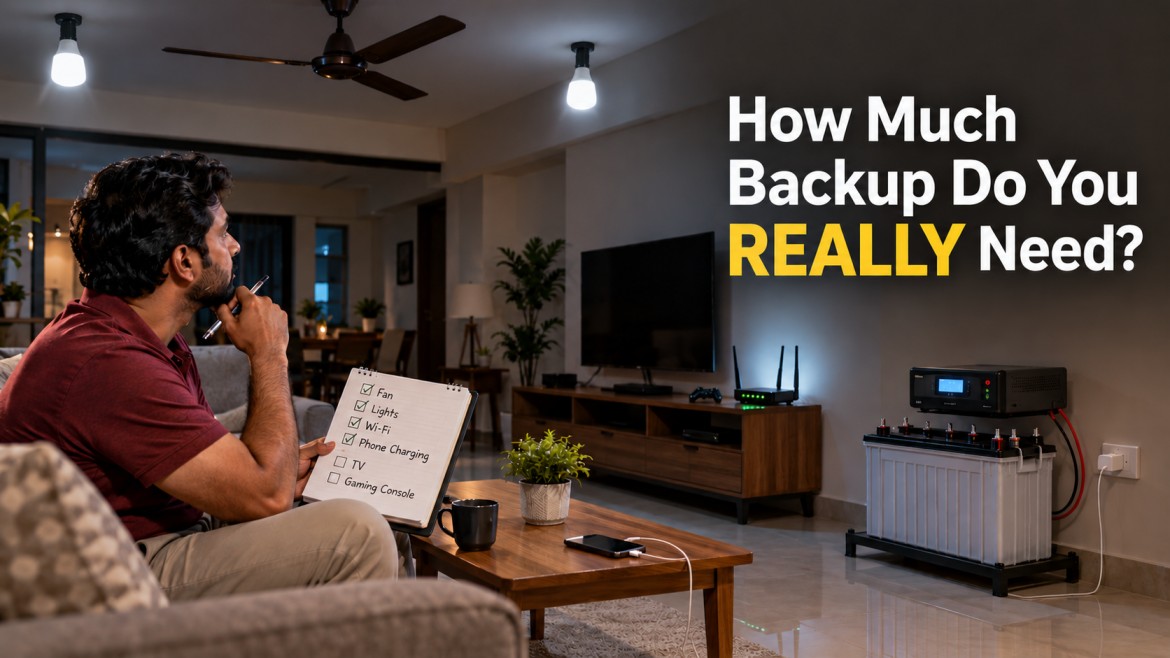
An excellent battery manufacturer does not start with the question “Which battery do you want?” But rather with the question “What is the requirement in case of a power failure?” Most customers want batteries that give the longest possible backup time. This usually results in purchasing an oversized system.
Planning for an effective backup always begins with distinguishing between necessary appliances and convenience appliances.
Start With What Must Stay On
Let us consider the case of an electricity outage at home.
There is a requirement of lighting, fans, wireless internet, and phone charging in most houses. These can be considered as basic requirements.
Next, let us take into account televisions, additional lights, gaming consoles, and other gadgets that can wait for the return of grid electricity.
They might be useful in some cases but are not necessary in all cases during an outage.
The basic difference in the above can make a significant difference in Battery Capacity required.
A house that runs two fans and four lights requires less stored energy compared to another house that needs three fans, a television set, wireless internet, laptop, CCTV system, and lighting.
Why A Battery Manufacturer Checks The Load First
Battery backup is directly proportional to load.
With more appliances in use, the battery uses up its energy supply at a quicker pace. This means that going for a bigger battery without considering the load won’t always help.
At Sakthi, we suggest that a customer starts with a very basic checklist:
- Appliances that should be ON
- Appliances that could be operated
- Expected hours of power failure
- Capacity of the current inverter
- Time available for charging
After having these points in hand, picking up an Inverter Battery for Home becomes quite easy.
It also avoids setting up unrealistic expectations. The customer might require six hours of battery backup and eventually find out that two or three will suffice.
Think About The Length Of Your Power Cuts
The requirements for a backup power supply depend on your location.
In some locations, blackouts last for 20 or 30 minutes. However, in other regions, the outages may last for several hours. A house with frequent outages needs a different strategy compared to a house with long outages.
Frequent outages create another problem. A battery gets less opportunity to charge itself between outages.
A reputable Battery Manufacturer needs to look into two things – backup duration and charging duration.
In case a region experiences an hour blackout, designing a plan to provide eight-hour backup will be an expensive option. On the other hand, having inadequate capacity in the battery can cause a situation where there will be no power even before the power grid comes back.
Comfort Loads Can Reduce Backup Quickly
A typical example of an error occurs immediately after the blackout.
The family goes ahead to use all the appliances assuming that the grid power is working normally. Several fans operate at maximum speed. The TV keeps working. Additional lights are kept on. Laptops and mobiles begin to charge simultaneously.
Of course, the battery drains faster.
What could have been done was to start with the basic loads first. In case the blackout seems to be brief, additional appliances may be powered. But in case of long blackouts, minimizing the unnecessary load increases the battery life.
That need not bring about much change. It is even enough to turn off just one additional fan or light.
Bigger Battery Capacity Is Not Always Better
A high Battery Capacity implies having more energy stored. However, it is important that the battery is well coordinated with the inverter and charging unit.
For instance, an oversized battery might take long to charge. This means that if the inverter has low charging currents, the battery will not have fully charged when the next power failure occurs.
Hence, customers should avoid basing their purchase of an Inverter Battery for Home on Ah capacity.
A battery, an inverter, the load, and charging period need to coordinate.
At Sakthi Accumulators, our priority is coordinating the product with use as opposed to suggesting high capacities.
A Simple Way To Plan Home Backup
Take a few minutes before purchasing and observe your home.
Count the number of fans, lights, and other things that you need. Also, count Wi-Fi, CCTV, laptops, and other necessary items for your home. Ask how many hours your electrical appliances will be in use when there is a power outage.
It will help the dealer understand your situation better.
This is because, while a home may only need fans, lights, and Wi-Fi in case of a power outage, an office needs computers, internet, and other things to function.
Sakthi’s Approach To Better Backup Planning
Here at Sakthi, we feel that battery choices must begin with the use.
A proper Battery Manufacturer will make sure to explain the relationship between the load, the amount of back up, the use of inverters, and how charging works.
To buy more than you need will make it expensive. To buy less than you need will give you inadequate back up.
The ideal battery is not always the largest.
It is the one which will ensure that the appliances you need run for as long as you need them to.
Frequently Asked Questions
1. How Do I Know How Much Battery Backup I Need?
List the appliances you must run during a power cut. Then consider their total load and the usual outage duration in your area.
2. Does A Bigger Battery Always Give More Backup?
A bigger battery can store more energy. However, actual backup still depends on load, inverter support, charging level, and appliance use.
3. Which Appliances Should I Run On An Inverter Battery For Home?
Fans, lights, Wi-Fi, CCTV, mobile charging, and essential work devices are common priorities.
4. Does Battery Capacity Affect Charging Time?
Yes. A higher-capacity battery may need more time to recharge, especially when the inverter has limited charging current.
5. Can Reducing Load Increase Backup Time?
Yes. Switching off non-essential fans, lights, televisions, or other devices can help the battery last longer.
6. Why Choose Sakthi For Home Battery Backup?
Sakthi focuses on matching battery capacity with real load, inverter support, charging conditions, and the user’s actual backup requirement.