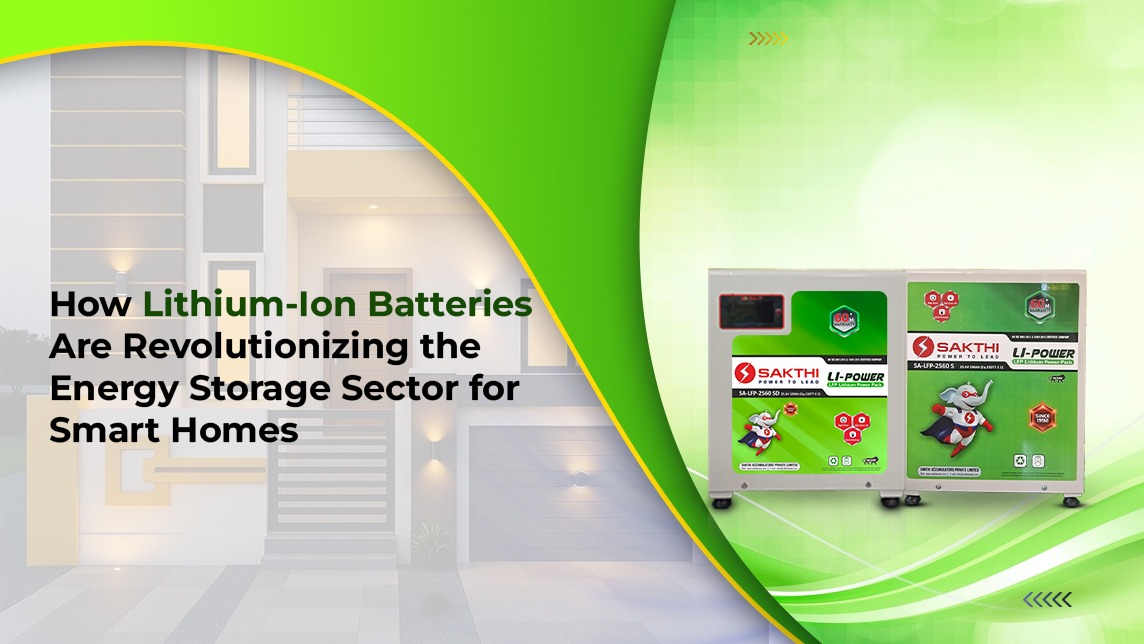
How Lithium-Ion Batteries Are Revolutionizing the Energy Storage Sector for Smart Homes

Think about this question: what’s the point of having an inverter if the battery can’t keep up when the power really goes out?

Power outages are unpredictable but always stressful. Lights drop, work pauses, and comfort disappears in seconds. This is exactly why lithium-ion inverter batteries have become the preferred choice for people who want backup power they can trust. And  Sakthi Accumulators, India’s best-known lithium-ion battery manufacturer offers Lithium-ion inverter batteries that have raised the bar in terms of performance and reliability.

Why Lithium-Ion Makes Inverter Backup Better

Traditional inverter batteries do the job, but they demand time and attention. They’re bulky, slow to charge, and need regular checks. Sakthi, one of the leading  lithium-ion battery manufacturers, manufactures  Lithium-ion that removes all that friction.

You get a compact, efficient, and cleaner power solution built for daily use.

Faster Charging, Better Readiness

One of the biggest advantages is how quickly it charges. With older batteries, waiting for a full recharge after a long outage felt never-ending. Lithium-ion inverter batteries shorten that wait drastically. Even if the power drops several times a day, the battery bounces back fast and stays ready for the next cut.

Longer Life With Lower Hassle

Durability is where a lithium-ion inverter battery truly shows its worth. Sakthi focus heavily on high-quality cells and built-in safety systems, which helps:

  • Reduce heating
  • Preserve charge for longer
  • Maintain performance under continuous load

Because the internal structure stays stable, the battery’s lifespan increases naturally. You save on maintenance and avoid the stress of frequent replacements.

Consistent and Predictable Backup

Many users complain about fluctuating backup times with older inverter batteries. Lithium-ion handles this better. A solid battery management system (BMS) ensures stability by monitoring:

  • Temperature
  • Cell balance
  • Charge and discharge patterns

The result? Consistent backup without sudden drops in output. For homes and offices depending on routers, lighting, and essential devices, this reliability makes a noticeable difference.

Simple Monitoring Features

Sakthi Accumulators, one of India’s most trusted lithium-ion battery manufactures, builds inverter batteries that support smart monitoring. With a simple app, users can easily check:

  • Battery health
  • Temperature
  • Remaining backup time

This removes guesswork and helps prevent sudden shutdowns.

Convenience + prevention = smoother daily use.

Designed for Local Conditions

Heat, inconsistent usage, and repeated outages can exhaust badly built batteries. But when the product is engineered in Sakthi Accumulators, India’s best-known lithium-ion battery manufacturer, who understands what the battery must endure. Local testing makes the final product more suitable for real, everyday conditions.

Why Upgrading Makes Sense

For anyone planning to improve their inverter setup, a lithium-ion inverter battery isn’t a luxury anymore. It is the smarter long-term choice because it offers:

  • Faster charging
  • Stable output
  • Longer lifespan
  • Lower maintenance
  • Compact form factor

As a trusted Lithium-ion manufacturer, Sakthi delivers high-quality inverter batteries that perform with excellence.

FAQs

  1. Does it require routine maintenance?

No. There are no water top-ups or heavy service needs.

  1. Can it run common appliances and office essentials?

Yes. Fans, lights, routers, and most work devices run smoothly.

  1. Does it charge faster than regular inverter batteries?

Absolutely. Quick charging is one of its biggest strengths.
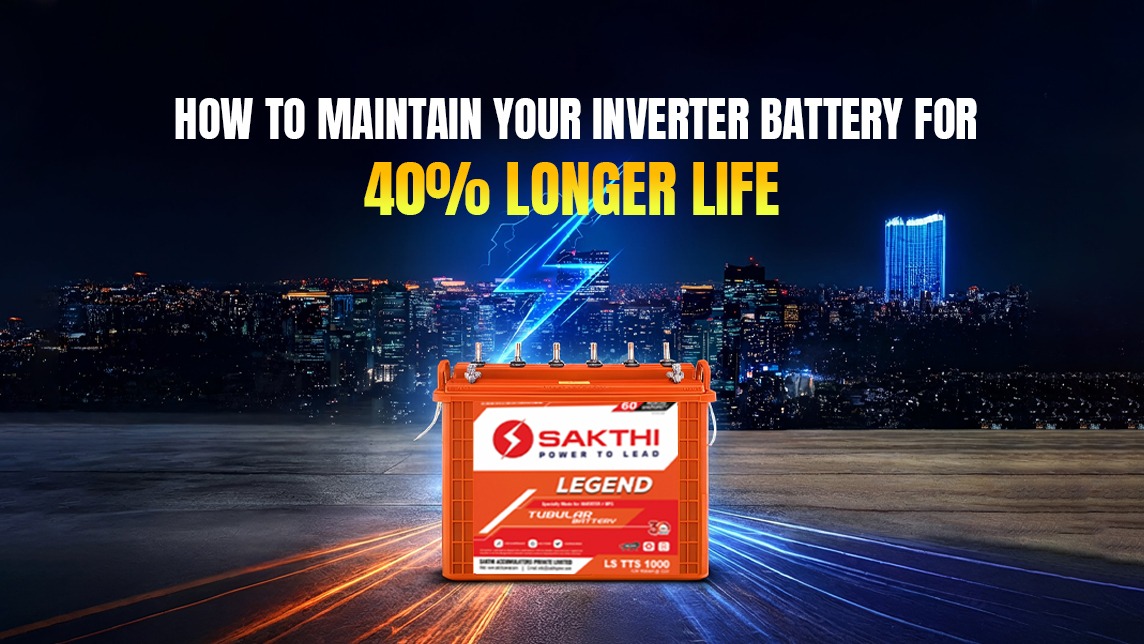
How to Maintain Your Inverter Battery for 40% Longer Life 

Even the best tubular battery for inverter loses capacity faster when heat, sulfation and irregular charging interfere with its internal chemistry. Since these reactions build up silently, users often wonder why their best battery for inverter weakens despite proper use. The answer lies in measurable electrochemical behaviour, not assumptions. That’s why Sakthi Accumulators, an experienced Tubular Battery Manufacturer, recommends a maintenance routine that directly slows chemical wear.

In this blog, Let’s see 5 steps that significantly extend battery life.

Controlled Temperature Slows Plate Corrosion (20°C–30°C Range)

Heat accelerates lead corrosion and increases water loss. Studies show that every 8–10°C rise doubles chemical degradation speed. Why it matters:

  • Tubular plates react more aggressively above 35°C.
  • Higher temperature reduces electrolyte density.
  • Backup time drops by up to 20%.

Keeping the inverter in a ventilated, shaded area keeps the battery for the inverter chemically stable and improves overall lifespan.

Full Charging Prevents Hard Sulfation (Major Life Killer)

When charging stays incomplete, soft sulfate crystals harden and become irreversible. This directly reduces plate activity. Scientific basis:

  • Full charging converts sulfate back into active material.
  • Incomplete charging increases internal resistance.
  • Voltage dips become frequent.

This is why the battery for inverters should always be allowed to fully recharge after every outage.

Balanced Electrolyte Ensures Ion Flow and Plate Health

Electrolyte level determines how efficiently ions travel within the battery. When plates stay exposed, oxidation begins immediately.

  • Low electrolyte reduces capacity by 25–30%.
  • Impure water increases sediment formation.
  • Incorrect levels disturb acid concentration.

Checking electrolyte every 30–45 days helps maintain the same chemical balance.

Clean, Tight Terminals Reduce Heat and Internal Resistance

Dirty or loose terminals create resistance, which generates heat and slows charging speed. Scientific connection:

  • Resistance spikes cause micro-heating.
  • Corrosion interrupts current flow.
  • Plate stress increases during discharge.

Cleaned and tightened terminals help deliver smooth, uninterrupted power.

Avoiding Deep Discharge Protects Active Material Structure

Discharging the battery below 20% remaining capacity accelerates active material shedding. Proven outcomes:

  • Deep discharge shortens cycle life by 30–40%.
  • Plate structure weakens under high load.
  • Tubular plates lose surface area over time.

Using essential loads only during long outages helps the Inverter battery stay structurally strong for years.

A Practical Path to Longer Battery Life With Sakthi

When these steps are applied consistently, inverter batteries experience significantly slower chemical wear. That’s why tubular battery for an inverter lasts longer when kept cool, fully charged and chemically balanced. The routine is simple, but its impact is measurable across actual field data.

If you prefer a battery designed for heat, frequent outages and long backup performance, consider Sakthi, trusted as a Tubular Battery Manufacturer in India. High-density plates and balanced electrolytes always create longer-lasting backup power.

FAQs

Q1. How often should I check the electrolyte level?

Every 75 – 90 days. This helps maintain chemical balance and prevents plate oxidation.

Q2. Can heat really reduce battery life?

Yes. Heat speeds up corrosion and reduces electrolyte density, which shortens cycle life.

Q3. Does a Sakthi tubular battery last longer than a flat-plate battery?

Yes. Tubular plates handle heat better and support deeper cycling, making them the best battery for inverters in most households.


The Smarter Power Shift: Why Lithium-Ion Inverter Batteries Hold Greater Appeal for More People

Power cuts are still an everyday challenging experience. And the responsibility of handling them hasn’t changed for most residential / commercial establishments in India; consequently, the first backup option is an inverter. But very often, it’s also the other component that needs equal care, such as the inverter battery.

Still relying on an old, bulky, slow-charging battery that needs an extra makeover, then you are relying on old technology. You are probably throwing away a lot more money than you want to understand.

More and more, people throughout India have begun to embrace lithium-ion inverter batteries, making a tangible difference in their daily lives, and backed by a number of innovative companies like Sakthi Battery, India’s best-known lithium-ion battery manufacturer.

Why Old Batteries Are Falling Behind

Traditional inverter batteries were never designed for the demands of modern life. They take hours to charge, need frequent water top-ups, and often struggle during long or repeated outages. Over time, their performance drops, and so does your backup.

Notice how the previous inverter battery is not performing like before, or if you’re spending more time checking fluid levels than actually using your inverter, Sakthi Battery, India’s best-known lithium-ion battery manufacturer in India is here to solve these problems.

Why are lithium-ion batteries preferred?

Lithium-ion inverter batteries have been engineered to cater to the contemporary power alterations. They charge faster, usually in a few hours.

They’re also lighter, smaller, and cleaner. No fumes, no spills, no bulky units eating up floor space. Just efficient, quiet, dependable power you can rely on when you need it most.

For homes, businesses, and even distributors looking for a dependable product line, lithium-ion inverter batteries offer a clear advantage. With manufacturers like Sakthi, one of the leading lithium-ion battery manufacturers in India, it is the end of your search.

Made in India, Designed for India

Sakthi, one of the leading lithium-ion battery manufacturers, because of our Indian roots, we understand the deep rooted energy needs of our people. Our lithium-ion inverter batteries are manufactured while keeping in mind Indian atmospheric conditions, daily charge-discharge cycles, and existing local infrastructure.

This results in battery durability and local product delivery. So, regardless of whether the purchase is made for homes or getting stock for your dealership, the presence of a trusted locally produced and designed battery from Sakthi, which is among the top lithium-ion battery manufacturers in India, will provide you with superior on-ground support and solutions, while also keeping the quality intact.

Ready to Switch? Here’s What to Do Next

The move to lithium-ion batteries isn’t just about new technology, it’s about quality living. Less worry. Fewer breakdowns. More peace of mind.

If you’re ready to start enjoying reliable backup power, instead of worrying about constant checkups, it’s time to upgrade. And when you do, trust a proven lithium ion battery manufacturer like Sakthi to power your next step forward.

Talk to a local expert. Ask questions. Compare your options.

And when you’re ready, choose a Sakthi, lithium ion battery manufacturer who stands behind their product and understands what your home really needs.

FAQ 

  1. My old inverter battery still works; why bother switching?

If it’s slow, needs care, or doesn’t last, you’re already dealing with the downside. Switching just saves you the stress.

  1. Is a lithium-ion inverter battery really that easy?

Yes. It is super convenient; it just charges up faster and enjoys a longer life without asking anything in return.

  1. Will I have to purchase an inverter as well?

Most likely not. Your setup is likely to work perfectly and your dealer will be the one to confirm this.

Kenzo Automotive Battery: Dependable Battery Power for Every Drive

Most drivers don’t think about their car battery until something goes wrong. But anyone who has been stuck with a vehicle that refuses to start knows how important a reliable battery truly is. That’s exactly why Kenzo Automotive Battery by Sakthi has been gaining attention. It’s a brand that focuses on practical performance- something you feel every time your car starts smoothly and runs without effort. And behind this brand is Sakthi, a steadily growing Automotive Battery Manufacturer known for producing dependable, long-lasting batteries.

Kenzo is a brand built around a simple idea: Indian roads need batteries that can deal with heat, dust, slow-moving traffic, and unexpected weather changes. Kenzo batteries are made with these real conditions in mind, which is why customers often describe them as “reliable” and “hard-working” rather than flashy or complicated.

Why Drivers Prefer Kenzo Batteries

Drivers usually look for three things in a battery—quick starts, long life, and minimal trouble. Kenzo checks these boxes without making things overly technical.

Smooth starting
A battery should bring the engine to life instantly. Kenzo batteries offer steady cranking power, whether your vehicle was parked overnight or left unused for a few days.

Life that feels longer
Many users mention that Kenzo batteries last longer than they expected. This comes from stronger internal parts and better resistance to corrosion and heat.

Built for rough and unpredictable roads
Indian roads can be demanding. Heat, vibration, and uneven routes often reduce battery life. Kenzo batteries are designed to handle these stresses with a stable internal build that doesn’t give up easily.

Low-effort maintenance
People today want simple ownership. Kenzo batteries fit that mindset- they don’t ask for frequent topping-up or constant monitoring.

How Sakthi Manufactures Its Batteries

The strength of Kenzo batteries reflects Sakthi’s approach to manufacturing. As a trusted Automotive Battery Manufacturer, the company focuses more on consistency than complexity. Their production unit uses equipment that maintains balance between precision and practicality.

A few things stand out in their process:

  • Regular quality checks instead of only final inspections

  • Testing batteries for heat, vibration, and output stability

  • Using materials that slow down corrosion

  • Manufacturing methods designed to reduce waste and environmental impact

This steady, methodical approach results in batteries that perform predictably, which is exactly what customers want.

Made for Different Driving Styles

Another reason Kenzo has a growing customer base is its versatility. It isn’t restricted to one category of vehicles. The batteries fit well with:

  • Regular cars used for daily office travel

  • SUVs that handle mixed terrains

  • Commercial vehicles that run for long hours

  • Two-wheelers that need quick starts in busy cities

Dealers and mechanics often recommend Kenzo because the batteries are easy to install and require minimal adjustments.

Kenzo’s Future Path

The automotive world is changing. Drivers expect more power, longer life, and products that can handle modern vehicles. Sakthi is preparing Kenzo for this future by improving materials, refining designs, and making the batteries more durable with each generation.

At its core, Kenzo remains a brand built on trust and practical performance. If you want a battery that simply works- without frequent maintenance- Kenzo is a safe and sensible choice. And with Sakthi being a well-regarded Automotive Battery Manufacturer, buyers get the confidence that their battery is backed by strong manufacturing experience and a commitment to quality.

Sakthi Inverter Batteries: Reliable Backup Power for Both Home and Industry

We have all felt that despair once in our life as the lights go out and our gadgets cease to operate.

That is exactly when Sakthi inverter batteries comes in handy. Especially their Legend Tubular Series, these batteries are designed to provide you with interruption-free (non-stop) power and keep your home or business operating. Whether you require it for your UPS / Inverter, Sakthi guarantee’s that you will never run out of power when you need it. Never Panic About Power Failure with Sakthi Inverter Battery!

Why Are Sakthi Inverter Batteries Fundamentally Different From Other Inverter Batteries Available In the Market?

Choosing the best inverter battery can be confusing, but here is why Sakthi is trusted by thousands. Some of the key highlights of Sakthi inverter batteries are as follows:

  • Durable Power: If well managed, it can last for 5-6 years due to strong internal construction and good material.
  • Low Maintenance: Only topping up water required every 4-5 months, makes it simple for day-to-day use.
  • High Effectiveness: With over 90% ampere-hour efficiency, and over 75% watt-hour efficiency, you can be sure that your inverter runs quite efficiently, with much backup time.
  • Versatile Use: Typically suited for UPS systems.

Inverter batteries should be chosen wisely!

Choosing the right battery is very important to ensure you have the appropriate backup and the longest life, Somethings to be considered while choosing your inverter batteries.

  • Consider Your Power Requirements: You need to know the watt ratings of the appliances you wish to use.
  • Determine the Length of Backup Time: Specify the time you would like to power the inverter.
  • Think About the Space Available: Make certain the battery fits in the space selected.
  • Remember Your Budget: Always factor in your installation, maintenance, and replacement cost.

When you think of these things, you will get the most from your Sakthi Inverter battery.

Power Your Life with Confidence And Sakthi

Are you tired of power outages ruining your day? Sakthi inverter batteries, specifically our Legend Tubular Series, are made to deliver you confidence and power to energize your daily life. When you know what your energy needs are and what battery will work best, you can rest assured that you will have power for your home or office uninterrupted.

Remember that reliability and efficiency are the priorities when it comes to inverters. You can be confident that your devices are secure from Sakthi, and you can operate and have leisure time worry-free. Take charge now and make investment decision for a reliable and intelligent backup power!!!

Uncovering the Progress and Problems of Lithium-Ion Batteries

Lithium-ion (Li-ion) batteries have emerged as the pillars of contemporary energy storage systems, driving everything from mobile phones to electric vehicles (EVs). Characterized by high energy density, long cycle life, and environmental friendliness, Li-ion batteries have transformed sectors. Nevertheless, in spite of their tremendous progress, they are still confronted with some problems that must be solved for their acceptance at large scale. In this article, we’ll explore both the advancements and challenges of lithium-ion battery technology and how they are shaping the future of energy storage.

Advances in Lithium-Ion Battery Technology

Increased Energy Density

One of the greatest developments in lithium-ion batteries is that they possess high energy density. This means Li-ion batteries store more energy in less volume and weight. More energy density in electric vehicles, for example, means longer driving ranges on a single charge, reducing “range anxiety” and making EVs more convenient to use on a daily basis. In the storage of renewable energy, also, more energy can be stored in smaller spaces, using up as much space as possible and reducing installation expenses.

Fast Charging Capability

Lithium-ion batteries have seen significant developments in fast charging technology. It used to take hours to charge an electric vehicle or other devices. With the development of Li-ion technology, charging has been reduced significantly. For example, there are certain recent electric vehicles equipped with fast charging, and they can charge up to 80% in 30 minutes. That is a big leap towards making EVs an easy alternative to use on a daily basis.

Extended Life Cycle

Li-ion batteries of today are backed by longer lifecycles of more than 3,000 full charge-discharge cycles, which was hard to achieve using older battery chemistry such as lead-acid. Apart from making fewer battery replacements necessary, this longer longevity also improves overall cost-benefit, especially in high-demand applications such as electric vehicles, solar back-up, and industrial applications.

Enhanced Safety

At the time of lithium-ion battery development in its early years, safety was a major concern, particularly overheating and fire-related issues. However, with advancing research in battery management systems (BMS), their safety has substantially increased. Modern-day BMS is designed with the ability to monitor the health of every cell separately, prevent overcharging, over-discharging, and thermal runaway, thus lithium-ion batteries become very safe to employ in consumer and industrial applications.

Limitations of Lithium-Ion Battery Technology

High Production Costs

High production cost is one of the largest barriers to mass acceptance. While the price of lithium-ion batteries has been declining year after year, it remains extremely costly relative to other types of battery technologies like lead-acid batteries. This is because of the high price of raw materials like lithium, cobalt, and nickel. The high cost lowers the price sensitivity of lithium-ion batteries in markets, although technology keeps on decreasing these costs.

Lack of Resources

Increasing demands for lithium-ion batteries have created scares about raw material shortages. Lithium, cobalt, and nickel are needed to manufacture these batteries, but they are limited resources that exist primarily in certain areas of the world. This could lead to supply chain disruption and price volatility, especially as the demand for electric cars and renewable energy storage systems grows.

Battery Degradation

Even though they have a long cycle life, lithium-ion batteries do lose their strength over time. After repeated charge cycles, the capacity and performance of the battery begin to deteriorate. Temperature, usage habits, and charging frequency determine this deterioration. As a result, users will need to replace the batteries sooner than expected, and that means there will be long-term sustainability problems and issues of environmental impact due to disposal.

Environmental Impacts of Recycling and Disposal

Although lithium-ion batteries are greener than lead-acid batteries, they pose an environmental risk when discarded improperly. Recycling lithium-ion batteries is intricate and costly, and disposal in the wrong manner leads to water and soil pollution. In order to overcome this, the implementation of latest recycling technologies and better means of recovering precious materials from used batteries is essential.

Conclusion

Lithium-ion batteries have advanced significantly as far as energy density, rate of charging, and lifespan are concerned and play a central role in modern technology. Lithium-ion batteries are the leaders among cleaner ways of energy, driving all from electric cars to clean power systems. But their proliferation is impeded by challenges like high cost of production, limited resources, aging of the battery, and recycling. All these must be tackled for lithium-ion batteries to realize their full potential.

At Sakthi Batteries, we follow these advances closely and are committed to bringing cutting-edge, reliable energy storage solutions. As the sector continues to evolve, we expect to incorporate new technology and improve battery performance to keep up with the growing energy requirements of our world.

Why is an Inverter Battery Required to Have Water? How Does an Inverter Battery Operate?

Sakthi Inverter Batteries are recognized for their sustained performance, dependability, and capability to supply continuous power in the event of grid outages. Whether powering your business or home, these batteries are engineered to deliver a seamless and undisturbed power supply. But like any battery, Sakthi Inverter Batteries need proper maintenance to perform optimally. One important aspect of battery maintenance is ensuring that the water level is correct. In this blog, we’ll dive into the science of how inverter batteries work and why they need water to keep running efficiently.

Why Does an Inverter Battery Requires Water?

Inverter batteries, particularly lead-acid batteries, depend on a combination of sulfuric acid and water to operate. The water within the electrolyte serves to preserve the chemical balance of the battery. When charging and discharging, water from the electrolyte evaporates, causing a drop in the water level. This drop of water levels may affect the efficiency and lifespan of the battery. Here’s why water is crucial:

Avoids Sulfation

With the decreasing water level, there is a rise in sulfuric acid concentration, which may result in the precipitation of lead sulfate crystals on the plates of the battery. Sulfation decreases the efficiency of the battery and may result in long-term permanent damage.

Maintains Electrolyte Balance

We put water in the battery to maintain the ratio of acid to water. Acid-to-water ratio is very essential to the operation of the capability of the battery to charge and discharge. If there is not enough water, the battery will not operate and may reduce the battery life significantly.

Maintains Protection of Plates

When water level is below par, the battery plates get exposed to air and dry out. This leads to lower capacity and eventually the death of the battery.

How to Add Water in Your Inverter Battery?

It is extremely simple to maintain the right water level in your inverter battery, but one must ensure to do it with caution so as not to do any damage. Here’s how to do it:

Inspect the Water Level:

Open the battery compartment and inspect the level of electrolyte. The water should cover the lead plates but not be over it. In case of low water level, the time has arrived to add some distilled water.

Use Distilled Water:

Always top off with distilled water, as the minerals in tap water can harm the internal parts of the battery. Never put sulfuric acid into the battery; simply use water to bring the electrolyte level up to the correct level.

Top Up Slowly:

Gradually refill the battery with the distilled water to the proper level. Don’t overfill the battery, as this can cause spillage when the battery is being used.

Check Periodically:

Daily check on the water levels, particularly if the battery is frequently used. Water levels must be checked at least once in every two months to maintain the maximum performance of the battery.

Conclusion

Maintenance of your inverter battery on a regular basis, like filling water when necessary, is essential to make your inverter battery function efficiently and also for a longer duration. By keeping the appropriate amount of water, you prevent sulfation, maintain the electrolytes at equilibrium, and prevent the battery plates from getting damaged. With proper maintenance, your inverter battery will keep supplying power at the time when you need it the most.

If you are looking for good inverter batteries, Sakthi Inverter Batteries offer durable and long-lasting products for all your energy storage needs. Both for residential and business purposes, our batteries are designed to keep running your systems with the highest efficiency and smoothness. Contact us today to learn more about our range of inverter batteries that are meant to energize your home with ease.

What is a Solar Carport? Maximizing Space with Sustainable Energy

As cities grow and the need for renewable energy increases, how we perceive ubiquitous areas itself is transforming. Parking lots, once nothing but car shelter space, are being repurposed as active energy-generating centers with the help of solar carports. These visionary structures bring solar panels into automobile parking rooftop space, generating clean energy while providing rain and sun shelter.

Solar carports are not merely an extension of solar facilities—these are the future of smart energy management wherein every available square foot can be harnessed towards sustainability. While integrating car cover with power generation, solar carports offer an operational solution to residential, commercial, and industrial customers who need to lower energy expenses and carbon emissions without compromising functionality.

Understanding Solar Carports

A solar carport is literally a car parking canopy that features solar panels on its roof. Though it simply shields cars from rain and the sun in a typical manner, the building also doubles as a mini solar power station, turning light into power.

In contrast to conventional solar rooftops, solar carports are mounted over open parking lots, and therefore they are suitable for residential estates, office buildings, commercial complexes, shopping malls, and even industrial parks.

How Does a Solar Carport Work?

The working of a solar carport is the same as any solar power system:

Solar Panels on the Roof absorb sunlight and convert it into direct current (DC) electricity.

Solar Inverter also converts DC electricity into alternating current (AC), which can be used to light homes, offices, or charge electric vehicles.

Battery Storage Systems (like Sakthi Solar Batteries’) can also store surplus energy to be used later, offering a safe backup during late nights or in the event of a power cut.

Surplus electricity can be fed into the grid (if net metering is possible), reducing the cost of electricity bills further.

Top Benefits of Solar Carports

Dual Utility – Shade + Electricity

Solar carports serve two purposes: they are a shade and weather protection to vehicles on one hand and a source of electricity on the other hand.

No Additional Land Required

Since carports are built above parking lots, they don’t need extra land—making them ideal for urban areas and business premises where land is costly.

Green Energy Savings

By generating green energy, consumers depend less on fossil fuels, reduce carbon emissions, and are contributing to sustainability goals.

EV Charging Integration

Solar carports can be coupled with EV charging stations to enable car owners to charge their electric cars directly from solar power.

Long-Term Cost Benefits

Although there is an initial expense, solar carports save electricity bills significantly throughout their lifetime. With battery backup, the savings are even greater.

Modern Aesthetic Appeal

Solar carports enhance the parking area along with the presentation of a brand or a home’s commitment to clean energy.

Solar Carports and Sakthi Batteries

At Sakthi Batteries, we provide high-end energy storage solutions that are ideal for solar carport installations. Our advanced batteries enable power generated during the day to be stored and used later, making carports even more efficient and reliable.

For apartment communities, office buildings, or industrial facilities, Sakthi solar batteries ensure continuous power and green performance. 

Conclusion

A solar carport is not just a parking shed—it is a smart energy solution that crosses convenience, sustainability, and innovation simultaneously. By generating clean power while utilizing available parking space, solar carports are leading the way to a greener tomorrow.

With Sakthi Solar Batteries‘ advanced storage systems, you can unlock the full potential of solar carports—offering energy security, cost savings, and environmental friendliness.

Invest in solar carports today with Sakthi Solar Batteries and drive towards a greener tomorrow.

How Lithium-Ion Batteries Work: A Complete Guide

In today’s energy-driven world, lithium-ion batteries are the cornerstone of many applications—laptops and smartphones to electric vehicles and renewable power storage. Their small size, high energy density, and long cycle life make them the most popular rechargeable battery technology today.

At Sakthi Batteries, we believe in empowering our customers with knowledge about the technology they rely on. Let’s explore how a lithium-ion battery works, step by step.

The Composition of a Lithium-Ion Battery

A lithium-ion (Li-ion) battery consists of three main components:

Anode (Negative Electrode): It is usually composed of graphite and holds lithium ions during charging.

Cathode (Positive Electrode): Composed of material such as lithium cobalt oxide, lithium iron phosphate, or lithium manganese oxide, it accumulates lithium ions when the battery is in the discharge state.

Electrolyte: Dissolving Lithium salt in an organic solvent which acts as the medium for the flow of lithium-ion between anode and cathode.

Separator: Thin, porous membrane that avoids direct contact between anode and cathode but allows the flow of ions.

This efficient but simple design enables lithium-ion batteries to provide high reliability and performance.

Charging Process – Storage of Energy

The moment a lithium-ion battery is connected to a charger, an external current is fed into it. This forces the flow of lithium ions from the cathode to the anode via the electrolyte. Simultaneously, electrons pass through the external circuit and also find their way to the anode.

Lithium ions intercalate (are stored) between graphite layers in the anode.

This is the process that “stores” energy and ready the battery to supply power at a later time.

The more ions that are stored in the anode, the higher the charge capacity of the battery.

Discharging Process – Providing Energy

When the battery feeds power into a device—a telephone or an inverter—the process reverses.

Lithium ions move back from the anode to the cathode via the electrolyte.

Electrons, rather than traveling inside, travel in the outside circuit, energizing the device that is attached to it.

This symphony of ions within the battery and electrons on the outside supplies the electricity that powers modern machines and appliances.

Electrolyte and Separator Function

The electrolyte is the “bridge” through which ions may travel but not electrons. Without it, ions could not move from the electrodes.

The separator provides safety through prevention of short circuiting with free passage of ions. These two features render lithium-ion batteries safe and efficient for repeated use.

Critical Lithium-Ion Battery Benefits

Lithium-ion technology has revolutionized energy storage because:

High Energy Density: Stores more power in smaller sizes.

Enhanced Cycle Life: Can be charged and discharged numerous times without the loss of capacity of battery.

Fast Charging: Charges quicker than nickel-based or lead-acid batteries.

Low Self-Discharge: Retains charge for longer when not in use.

Lightweight and Compact: In applications where portability is important and EVs.

These advantages are why lithium-ion batteries are replacing traditional lead-acid batteries in many sectors.

Uses in Contemporary Life

Lithium-ion batteries are ubiquitous today:

Consumer Devices: Smartphones, laptops, tablets, cameras.

Electric Cars: Fueling the green mobility revolution.

Solar & Renewable Storage: Storing energy from solar panels and wind turbines.

Industrial Uses: Robotics, medical equipment, and backup power systems.

At Sakthi Batteries, we are experts at producing lithium-ion solutions that are not only efficient but also customized for Indian conditions and global needs.

Conclusion

The functioning of a lithium-ion battery can seem simple—ions moving back and forth between electrodes—but this sophisticated process is what drives the digital and electric age. With the highest energy density, fast charging, and long service life, lithium-ion technology is shaping the future of energy storage.

At Sakthi Batteries, we are happy to offer innovative lithium-ion batteries that meet the power requirements of today and the potential of tomorrow. For homes, industries, or organizations, our offerings ensure reliable, green, and high-performance power every time.

Is Your Car Battery Not working? Here’s Why Sakthi is the Upgrade You Need

A car battery is the lifeline of your vehicle’s electrical system. It powers everything—from engine ignition to headlights, audio systems, and air conditioning. But despite its importance, many drivers overlook the early warning signs of a failing battery—until the car refuses to start. Timely detection of battery issues not only saves time and money but also protects your car’s overall health.

In this article, we highlight the key signs that your car battery needs replacement and explain why Sakthi Car Battery, an established automotive battery manufacturer, is the smart choice for Indian driving conditions.

Slow or Struggling Engine Start

One of the most noticeable signs of a weak battery is a slow or delayed crank when you start the engine. If your vehicle takes longer to start or sounds sluggish while cranking, it could mean the battery is unable to deliver adequate power.

Why it happens:
Over time, batteries lose their ability to hold a full charge. Temperature changes, frequent short trips, and aging reduce efficiency.

Why Sakthi?
As a trusted automotive battery manufacturer, Sakthi Car Batteries are built with high Cold Cranking Amps (CCA) that ensure quick starts even in extreme weather. Whether you’re in the chilly north or the humid south, Sakthi offers dependable ignition every time.

Dim Lights and Malfunctioning Electronics

If your headlights are unusually dim or your car’s electronics (radio, windows, dashboard lights) behave erratically, it’s likely a dying battery.

Why it happens:
A failing battery cannot maintain the voltage needed to power multiple systems.

Why Sakthi?
Sakthi batteries are engineered for consistent voltage output and use advanced plate design. As an innovative automotive battery manufacturer, Sakthi ensures stable power to all electronics for a smooth and glitch-free ride.

Battery Warning Light on Dashboard

Modern cars display a battery warning light when there’s a charging system issue. If the light stays on, your battery might not be charging properly—or the alternator could be failing.

Why it happens:
Voltage irregularities trigger this warning to prevent sudden breakdowns.

Why Sakthi?
Sakthi batteries undergo strict quality checks and are built to be alternator-friendly. As a customer-focused automotive battery manufacturer, Sakthi also offers robust service support and clear warranty coverage.

Frequent Jump Starts

If your car frequently needs jump-starting—even after short drives—it’s a major red flag.

Why it happens:
Battery plates may be sulfated or internally damaged, reducing their capacity.

Why Sakthi?
Sakthi batteries feature deep cycle capabilities and low self-discharge rates, designed to perform even under stop-and-go traffic or high-load usage. That’s the level of durability you’d expect from a top-tier automotive battery manufacturer.

Battery Age Over 3 Years

Even with no symptoms, batteries should be tested after three years of use.

Why it happens:
All batteries degrade over time, regardless of usage.

Why Sakthi?
With corrosion-resistant components and a rugged build, Sakthi Car Batteries offer a longer lifespan—especially important in India’s varied driving conditions.

Why Sakthi is the Smart Replacement Choice

When it’s time for a new battery, not all brands offer the same value. Sakthi Car Batteries stand out for:

  • ✅ Designed and manufactured in India, for Indian roads
  • ✅ Compatible with all major car brands
  • ✅ Quick recharge technology
  • ✅ Environmentally conscious design
  • ✅ Trusted dealer and service network

As a responsible and experienced automotive battery manufacturer, Sakthi offers not just a product—but peace of mind on every journey.

Conclusion

Recognizing the early signs of a failing battery—like slow starts, dim lights, dashboard warnings, and repeated jump-starts—can help avoid unplanned breakdowns and costs.

When you notice these symptoms, don’t wait. Upgrade to Sakthi Car Battery, a name trusted by thousands and backed by a leading automotive battery manufacturer. Power your journey with confidence. Power it with Sakthi.